
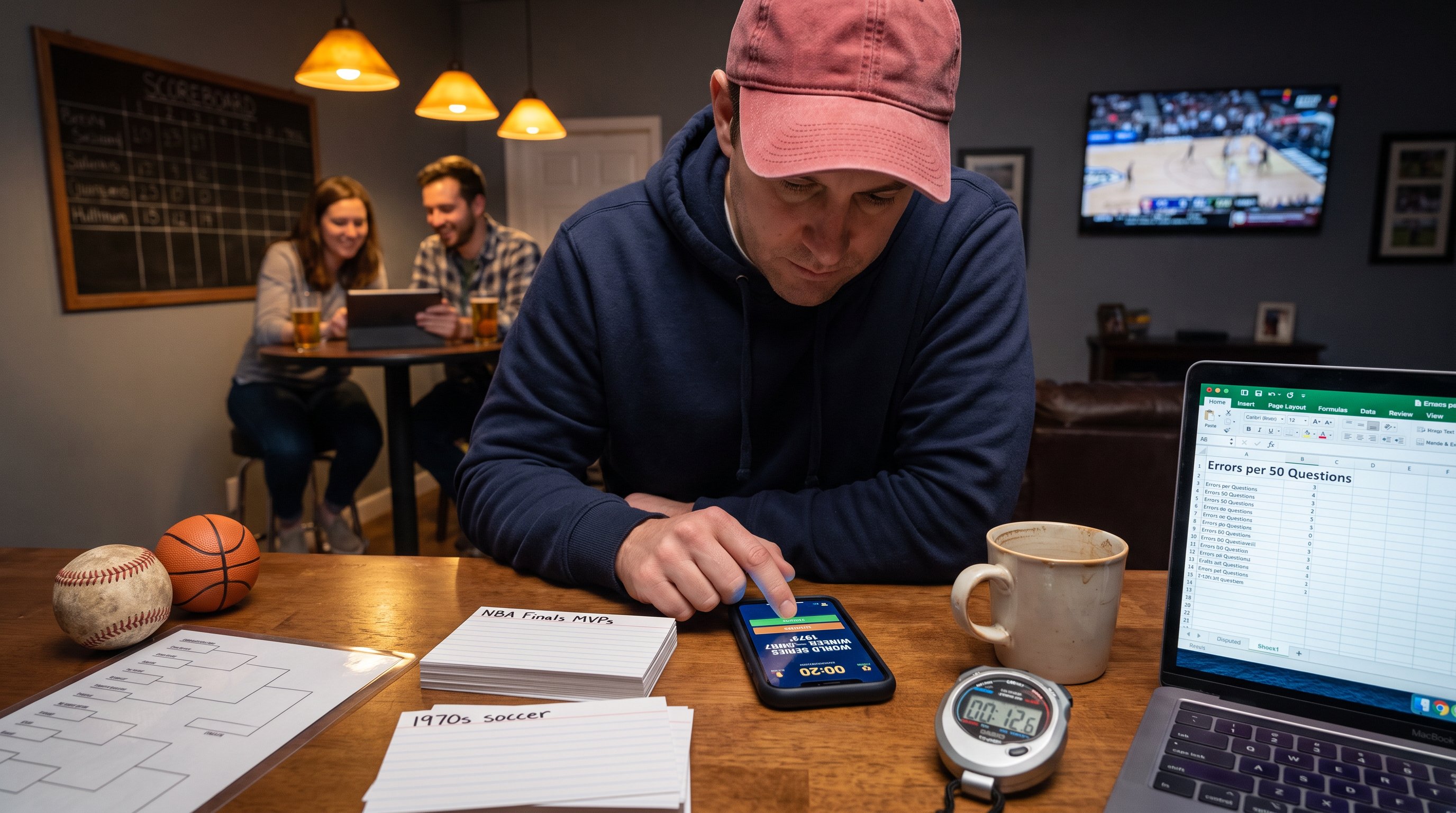
The Best Ways to Test Your Knowledge with Sports Trivia begins with a single habit: deliberate recall. Readers who want sharper recall, faster answers, and clearer gaps start short sessions that force retrieval, not passive reading. This article lays out practical solo drills, tool recommendations, and competitive formats that help fans convert casual knowledge into consistent trivia performance.
Key Takeaways
- Deliberate recall through timed quizzes and spaced flashcards significantly improves sports trivia knowledge and long-term memory retention.
- Tracking errors during practice helps identify specific weak areas, allowing more efficient and targeted study sessions.
- Using apps like Snapback Sports Trivia and Brainscape that support spaced repetition and diverse question types boosts solo practice effectiveness.
- Creating custom question banks from missed items and applying mnemonic techniques accelerate recall speed and accuracy.
- Competing in social formats or online leagues enhances motivation, exposes players to varied questions, and improves performance under pressure.
- Hosting or joining structured trivia events with balanced difficulty and clear timing rules ensures engaging and fair competition.
Why Testing Your Sports Trivia Knowledge Matters
Answer first: testing builds durable memory and reveals specific weaknesses. Recalling a score, a champion, or a year under pressure strengthens long‑term storage more than rereading game recaps. For example, a fan who practices five-minute daily quizzes for 30 days typically retains facts about teams and records far longer than someone who reads an article once.


Context and evidence: spaced retrieval and timed recall train both accuracy and speed, skills needed for pub quizzes and live online leagues. Testing also surfaces blind spots: a player might know modern NBA MVPs but blank on World Cup winners before 1990. Identifying those gaps makes study efficient: focus on eras or sports that cause the most misses.
Practical metric: track errors per 50 questions. If errors fall from 18 to 6 over two weeks, that’s measurable progress. That kind of measurement makes practice purposeful rather than aimless.
Best Solo Methods To Test Yourself
Answer first: solo practice should mix active quizzes, spaced flashcards, and time pressure. Those three elements produce the biggest gains.
Practical routine: start with a 10-minute timed quiz, review missed items with a flashcard app, then end with one quick lightning round tied to a single sport. This structure keeps sessions short and repeatable, vital for maintaining a streak.
Why it works: timed quizzes train retrieval under pressure: flashcards use spaced repetition to move facts into long-term memory: topic drills let the learner correct weak areas. A weekday plan could be: Monday, baseball records, Wednesday, soccer champions, Friday, mixed lightning quiz. Over a month this yields targeted improvement without burnout.
Top Apps, Flashcards, And Quiz Tools For Solo Practice
Answer first: choose apps and flashcards that use spaced repetition and varied question types. Examples matter: apps like Snapback Sports Trivia and Quizivo offer multi‑sport banks and leaderboards: Brainscape hosts repeatable flashcard decks for champions and records.
Specific tools to try: Snapback Sports Trivia for quick rounds, Brainscape for SRS flashcards, and Quarter Quiz – Sports for focused era tests. Those apps let a user tag missed questions and export them as custom decks.
Practical tip: integrate data sources. When a question references a player stat, cross-check with a reliable database. A user who builds a custom deck from verified records reduces errors caused by faulty trivia questions. For broader context on databases and stats sources, readers can consult a recommended overview of useful sports databases, which helps when sourcing accurate questions.
Timed Quizzes, Self-Made Question Banks, And Memory Techniques
Answer first: combine timed drills with custom question banks and mnemonic strategies. Timed practice forces faster recall: custom banks focus study where it’s needed: mnemonics make dates and sequences stick.
How to build a bank: capture every missed question into a spreadsheet or flashcard deck with tags like “1970s soccer” or “NBA Finals MVPs.” After 100 captured items, sort by tag frequency and attack the most common weak area for one week.
Memory techniques to apply: use loci for lists (place five World Series winners along a room), create vivid micro‑stories for odd facts (imagine a goalie painting the 1966 World Cup trophy), and use number‑shape systems for specific years. Track improvement: if average response time drops from 12 seconds to 6 seconds on a set of 50 items, the training approach is working.
A final note: adaptive flashcards that escalate exposure for missed items save time, spend 70% of study time on the 30% of items you miss most.
Social And Competitive Ways To Test Sports Trivia Skills
Answer first: competing against others accelerates performance and reveals stress points. Social formats expose players to novel questions and timing pressure that solo drills can’t replicate.
Live apps and leaderboards: many mobile platforms host head‑to‑head modes and global leaderboards. Playing against others highlights habits, some fans answer too slowly, others miss older eras. Social play also introduces unpredictable question wording, which improves comprehension.
Measured benefits: a player who joins weekly competitions often reduces recall time by an average of 20–30% over two months versus solo practice alone. Social play also provides motivation: single players who switch to leagues maintain practice frequency 40% longer because of community accountability.
Useful internal references: fans preparing for social contests will find tips on how to follow multiple leagues without missing stories in a guide to follow several leagues, and can sharpen stat interpretation via a short primer on reading player statistics.
How To Host, Join, Or Compete In Trivia Nights And Online Leagues
Answer first: pick a format, prepare balanced questions, and set clear timing rules. That makes events fair and fun.
Hosting checklist: choose a mix of difficulty (40% easy, 40% medium, 20% hard), include timed rounds (30–60 seconds), and limit sport overlap to avoid specialist domination. Use app features or a shared spreadsheet to score and to publish leaderboards after each round.
Joining leagues: seek weekly or monthly competitions that publish question archives. Playing archived rounds helps rehearsal, treat past league questions as practice sets. For remote play, use app‑based live quiz modes or daily leagues: ESPN’s weekly quiz is a concrete example of regular testing for dedicated fans, and it can serve as a consistent benchmark for progress.
Preparation tips: build three practice sets from flashcards, one for recent seasons, one for historical milestones, and one random mixed set. Invite friends and assign one person to verify facts against a trusted source. For additional broader fan context and community culture, consult a pillar overview of fan culture and analysis before hosting larger events.
Conclusion
Testing works when it’s deliberate, measurable, and social. A mix of timed solo drills, adaptive flashcards, and competitive play produces faster recall and clearer knowledge maps. Readers who track misses, lean on reliable databases, and join regular competitions turn scattered facts into dependable trivia performance.