

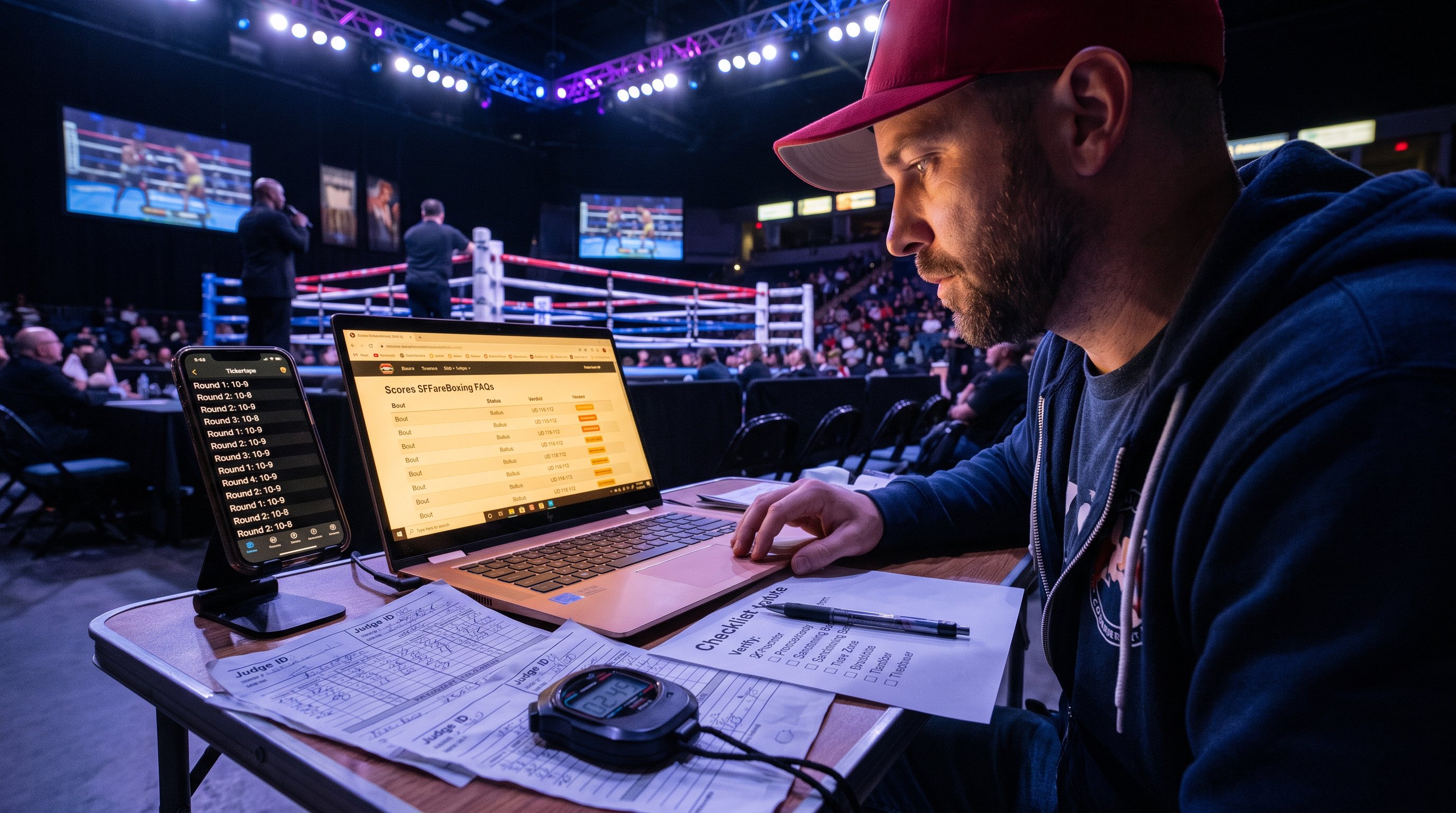
SFFareBoxing’s role as a coverage label begins with listings for fights, status, and results that let fans follow a card. This FAQ explains how SportsFanFare collects schedule and score data, how live updates work, what verdicts mean, and what to do when a result looks wrong. It aims to give practical steps and clear examples so a reader can verify a score, report an issue, or simply understand a judge’s card.


Key Takeaways
- Scores SFFareBoxing aggregates boxing event schedules and results from multiple official sources, providing fans with timely fight status and scoring updates.
- Live scores on SFFareBoxing use the 10-point must system to display round-by-round and final verdicts, helping users understand judges’ decisions through clear abbreviations like UD, SD, MD, KO, TKO, and DQ.
- If scores seem incorrect or delayed, users should verify event time zones, check for duplicate entries, and consult official promoter or sanctioning body feeds before reporting errors.
- SFFareBoxing emphasizes data accuracy by linking scores to official judges’ cards and sanctioning bodies, making it a reliable but not an official judging source.
- To report errors on SFFareBoxing, users must document the official source, capture event details, and submit corrections through SportsFanFare’s partner channels with supporting evidence for prompt resolution.
How SFFareBoxing Collects And Displays Boxing Scores
SFFareBoxing pulls fixtures and result records from synchronized feeds and manual edits to build each event page. The fact: SportsFanFare structures entries as fixtures that include date, time, venue, status, and result fields. That means scores often appear as part of a schedule record rather than a dedicated live-scoring engine.
Context and mechanics: feeds may come from promoter releases, broadcaster tickers, sanctioning bodies, or partner APIs. SportsFanFare’s guide to using its boxing fixtures explains where to find filters and sync options and how to match a fight to its card. For readers who sync schedules, the site’s step-by-step walkthrough on sffareboxing fixtures helps users find and filter events without losing update context.sffareboxing fixtures
Practical example: when a night of fights is scheduled, SFFareBoxing will show “scheduled” or “final” next to the bout. If judges submit scorecards, the site displays the final verdict and the numbers as entered in the results feed. This arrangement is why SFFareBoxing works best as a consolidated schedule and results index rather than an official judging source.
How To Interpret Live Scores And Real-Time Updates
Answer first: live scores on SFFareBoxing reflect round-by-round tallies translated into final verdict labels using the 10-point must system. In short: judges award each round, and those totals produce the displayed score.
How it appears live: during a fight, a live feed may show per-round tallies like 10-9 or 10-8, then final totals such as 116-112. SFFareBoxing typically converts those totals into result lines and verdict abbreviations. For a deeper primer on the 10-point system and how judges assign points, the explainer on boxing scoring breaks down the core rules used across professional cards.boxing explainer
What to watch for: an early knockdown often produces a 10-8 round. A dominant performance without a knockdown may still be 10-8 in rare cases. Scores posted mid-fight may update after each round or only after official submissions: hence, a mid-round display can change when official cards are filed. SFFareBoxing shows status labels to signal whether a score is provisional or final.
Nearby follow-up: if a displayed score seems inconsistent, check the official sanctioning body or broadcaster feed listed on the event page before assuming an error.
Common Score Types And Verdicts (UD, SD, MD, KO, TKO, DQ)
Answer first: verdict abbreviations summarize how judges or officials decided a fight. Each label indicates a distinct outcome and how many judges agreed.
Definitions with numbers: UD (unanimous decision) means all three judges had the same winner. SD (split decision) means two judges favored one fighter and the third favored the other. MD (majority decision) occurs when two judges pick one fighter and the third scores a draw. KO (knockout) means a fighter could not continue after a legal blow: a KO typically ends the bout immediately. TKO (technical knockout) happens when the referee, ringside physician, or corner stops the fight: it often follows sustained dominance or injury. DQ (disqualification) is rare and used when a fighter’s fouls or repeated rule breaches end the contest.
Concrete example: a final line of 116-112, 115-113, 114-114 becomes a majority decision for the fighter with two winning cards. SFFareBoxing displays those totals and the verdict label so readers see both numbers and the decision type.
Troubleshooting: Missing, Delayed, Or Conflicting Scores On SFFareBoxing
Answer first: missing or conflicting scores usually trace to feed delays, time zone errors, or mismatched event IDs between sources. That explains most discrepancies on schedule-driven pages.
Step-by-step checks: 1) Confirm the event time and time zone displayed on the fight page: SFFareBoxing schedules sometimes show local venue time while feeds publish UTC or broadcaster time. The site’s schedule overview helps reconcile these times when syncing events.schedule sffareboxing
- Verify whether the page lists a promoter or broadcaster. Official promoter results or sanctioning body confirmations take precedence over third-party feeds. 3) Look for duplicate entries: fixtures imports can create two similar cards, causing apparent conflicts: checking the platform’s fixtures today examples can reveal duplicates and how updates propagate.fixtures today
If scores are delayed: wait for the sanctioning body’s official card or the broadcaster to file the results. If scores conflict: cross-check with the event’s official results page or a trusted results roundup. SportsFanFare’s results archive gives historical confirmation when available.results sffareboxing
Practical warning: don’t repost provisional mid-fight tallies as final. A single corrected card can flip a decision.
Accuracy And Reliability: Sources, Verification, And Update Frequency
Answer first: accuracy depends on the primary source, official judges, sanctioning bodies, and broadcasters. SFFareBoxing aggregates those inputs, so reliability mirrors source reliability.
Where numbers come from: judges’ round-by-round scorecards are the official record. Aggregators like SportsFanFare receive those cards via partner feeds or manual entry and then publish them as fixtures or results. The platform emphasizes timely updates and provides sync tools for feeds, but it does not act as a sanctioning authority. For readers wanting the official rules and scoring background, the scoring explainer clarifies how rounds convert to totals and which actions matter most in judging.boxing explainer reference
Update cadence: SportsFanFare’s fixtures are designed for quick refreshes: but, the site does not publish a fixed refresh interval for boxing scores. Expect real-time-like updates during major broadcasts and hour-delayed updates when feeds are manual.
Trust checklist: prefer results that include: (a) judge names or ID numbers, (b) per-round tallies, and (c) an official sanctioning body confirmation. SFFareBoxing typically links or references these details in higher-profile events, and the boxing calendar pages demonstrate where those confirmations appear.fixtures sportsfanfare
Aggregated platforms speed discovery but cannot replace an official scorecard when controversies arise. That distinction is part of SFFareBoxing coverage across scores, records, and analysis, along with trust checks and alternatives.
How To Report An Error Or Suggest A Correction To SFFareBoxing
Answer first: report errors by documenting the official source and submitting the discrepancy through SportsFanFare’s feed or partner channels. The site lacks a boxing-specific corrections form, so the documented route is preferable.
Exact steps to follow: 1) Capture the official source (promoter statement, sanctioning body release, or broadcast screenshot). 2) Note the SFFareBoxing event ID, date, and the incorrect fields (score totals, verdict label, time zone). 3) Use the site’s partner or developer contact sections to submit the correction request with your evidence. The guide to using SFFareboxing fixtures explains how feeds and edits are managed and which partner channels exist for fixes.fixtures guide
What to expect: feed corrections often take minutes to hours depending on source verification. If the issue is a duplicate or schedule mismatch, the scheduling guide and the hockey feed example show how administrators reconcile duplicate records and update timestamps.scores feed example
Practical tip: include a screenshot of the official scorecard and a link to the sanctioning body to speed verification.
Conclusion
Scores SFFareBoxing can serve as a schedule-and-results index when readers treat it as an aggregator. For official verification, rely on judge cards, promoters, and sanctioning bodies. For readers who need official records, faster live updates, or deeper reporting, a comparison of boxing sites by information need separates the strongest option for each task. When confusion appears, document the official source and check time zones and duplicates.