
SFFareBoxing Fight Scorecards Explained opens the door to reading fight cards like a pro. This guide gives the core facts first: SFFareBoxing uses the 10-point must system, three judges, and round-by-round lines that add to a final card. Readers will learn how judges assign 10–9, 10–8 rounds, how knockdowns and fouls change totals, and why close cards spark controversy. The piece is practical, with examples, warnings about common misreads, and links to schedules and results for fans tracking bouts.


Key Takeaways
- SFFareBoxing fight scorecards use the professional 10-point must system with three judges scoring each round independently to determine fight outcomes.
- Judges assign 10–9 for close rounds, 10–8 after one knockdown, and adjust scores for fouls, making round-by-round reading essential to understand momentum and critical moments.
- Four key judging criteria are clean punching, effective aggression, ring generalship, and defense, with clean punches weighted most heavily in scoring rounds.
- Variations in judges’ perspectives and scoring styles explain common controversies and split decisions, emphasizing the need to review individual round scores rather than just final totals.
- Fans should always consult SFFareBoxing’s published schedules, results, and round-by-round cards to verify scoring details and avoid misreading fight outcomes.
How SFFareBoxing Scorecards Are Structured
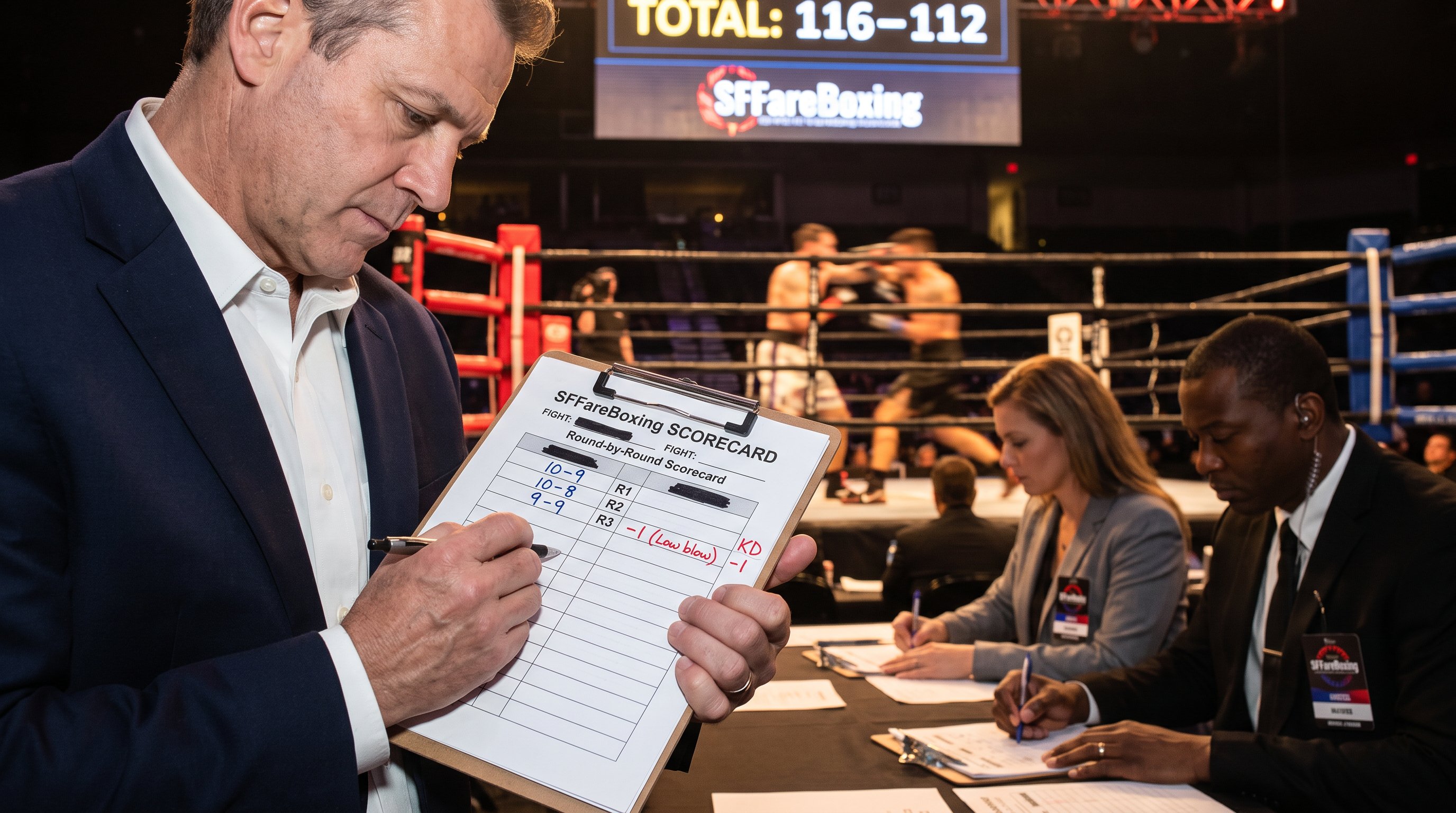
Fact first: SFFareBoxing scorecards follow the professional 10-point must system with three independent judges. Each judge writes a line for every round and awards the round winner 10 points and the loser 9 or fewer. At the end, a judge totals those round scores into a card (for example, 116–112). The three cards together decide the fight outcome: unanimous decision, split decision, majority decision, or draw.
Structure details and numbers: each fight typically has 10 to 12 rounds for main events and fewer for undercards. Judges sit on different sides of the ring and record per-round scores such as 10–9 for a close round, 10–8 after one knockdown, and 10–7 after two knockdowns in the same round. Fouls show as point deductions on that round’s line, which changes the numeric entry (for example, a 10–9 round with a one-point deduction becomes 9–9 on that judge’s card).
Before drawing a conclusion from the final number, score-reading checks before citing a result include reading each round line by line. A card that reads 10–9, 9–10, 10–8, 10–9 tells a different story than simply seeing the final 116–112. SFFareBoxing publishes schedules and fight pages so fans can cross-check when a judge scored a pivotal round differently: the site’s event schedule and context help viewers follow rounds in real time with the published schedule and lead into post-fight analysis.
Practical note: judges must record every round independently. That means a single judge’s pattern of awarding many 10–9s to the aggressor can produce a split decision even when punch stats favor the other fighter. Fans should look at individual rounds, not only the totals, to see where judges diverged.
Round-By-Round Scoring: What Judges Look For
The judging criteria behind published score explanations include clean punching, effective aggression, ring generalship, and defense. Clean punching counts most: judges reward decisive, visible, and hard shots that land on target.
Clean punching: judges track punches that land flush. A clean right hand that snaps the head back counts more than a flurry of wild swings that miss. Concrete example: if Fighter A lands 25 clear power shots and Fighter B lands 35 light glancing jabs, many judges favor Fighter A for clean punching.
Effective aggression and ring generalship: aggression must be effective. Pushing forward without landing does not win rounds. Ring generalship describes who controls distance and tempo. If a fighter forces the action, cuts off the ring, and lands on the break, judges reward that control.
Defense: slipping, blocking, and countering reduce the value of an opponent’s offense. A fighter who avoids two big shots in the last 30 seconds may swing a close round in his favor.
Scoring patterns and numbers: a competitive round is usually 10–9. One knockdown commonly produces a 10–8 round. Two knockdowns often become 10–7, though judges may vary. A rare 10–10 appears when a round is utterly even.
Evidence and verification: the 10-point must system’s framework mirrors mainstream boxing practice. Readers can compare the SFFareBoxing method to traditional pro standards via a boxing explainer that outlines how judges award points under this system, which helps ground SFFareBoxing’s round-by-round logic in established scoring practice official explainer.
Practical warning: commentators and live stats can mislead. Crowd noise and replay angles bias perception. Judges rely on direct observation and the four criteria, not fan reaction.
Interpreting Scorecards, Common Pitfalls, And Controversy
Close-round disagreement is part of how SFFareBoxing connects scores, records and analysis, where score interpretation sits beside result reporting and fighter context. Judges sit at different positions and literally see different punches land. A punch blocked on one side can look clean on the other, producing divergent round scores.
Pitfall, all 10–9s count the same: SFFareBoxing cards treat every 10–9 equally on the totals. That can mask dominance. For example, Fighter X may lose six rounds narrowly (10–9) and win six rounds decisively with knockdowns (10–8). The totals can still read close even when one fighter clearly dominated parts of the fight.
Pitfall, subjectivity and judge style: some judges favor aggression and forward movement: others reward counterpunching and defense. That variation explains split decisions where two judges see things one way and the third disagrees. Fans should note patterns: a judge who gives many 10–8s will shift the final math compared with a judge who avoids them.
Practical example and numbers: consider a 12-round fight where Judge A scores 116–112 for Fighter A, Judge B scores 115–113 for Fighter B, and Judge C scores 115–113 for Fighter A. The result is a split decision for Fighter A even though totals are tight. Reading each round explains where Judge B flipped a pivotal middle round.
When a published card changes, timestamps and corrections on boxing-result pages show readers what was updated and when. SFFareBoxing uses post-fight published cards so independent analysts can spot rounds with conflicting scoring. Fans often miscount live, especially when broadcasts focus on highlights. That is why SFFareBoxing posts complete results and detailed recaps to check round-by-round entries.
A cautionary tale: a fan once assumed the loud fighter was winning and shouted after every exchange: he later learned the quieter counterpuncher had actually scored three clean rounds in a row. That moment teaches a lesson: watch rounds in sequence, note knockdowns and point deductions, and trust the written card over crowd noise.
How to read a controversial card: first, confirm whether knockdowns or fouls changed a round’s score. Second, compare judges’ round-by-round lines. Third, look for consistent patterns, did one judge favor aggression while others favored counters? Finally, consult the published SFFareBoxing fixture pages for official context, like bout length and scheduled rounds, which affect judging strategy and expectations found in the fixtures guide.
Recommendation: when a decision looks wrong, map each judge’s 10–9s and 10–8s across rounds. That simple table often shows where perceptions diverge and whether a protest would rest on a scoring error or a genuine difference of opinion. SFFareBoxing’s event pages and historical fixtures help place a controversial card in broader competitive context.
Conclusion
Key takeaway: SFFareBoxing Fight Scorecards Explained shows that the 10-point must system, round-by-round entries, and three independent judges create both clarity and room for debate. Fans should read cards line by line, watch for knockdowns and deductions, and factor judge vantage and style into any post-fight assessment. When in doubt, consult the official SFFareBoxing schedules and results to verify round counts and official totals.