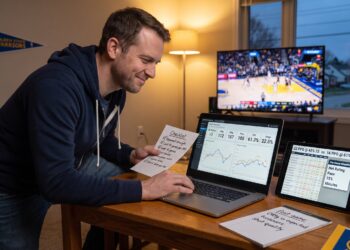

Walk into any sports bar in Austin on a Saturday in September and you’ll hear it before you see a single snap. “Longhorns minus 14.” “Take the under.” “Book’s moved half a point since Wednesday.” Nobody at that bar can legally place a bet on any of it. Not through a licensed app, not at a kiosk, not anywhere inside state lines. And yet the spread talk never stops.
That’s the strange contradiction sitting at the center of Texas sports culture right now. The state produces some of the most bet-upon programs in the country, Texas, Texas A&M, the Cowboys, and its residents follow the numbers as closely as anyone in Nevada or New Jersey. They just can’t act on them without leaving the state, digitally or otherwise.


Lt. Gov. Dan Patrick made the state’s position blunt in December 2025, saying he’s “simply not there yet” on legalizing sports betting or casinos, with the next real legislative push not expected until 2027. Two more football seasons, minimum, before Austin even reconsiders. Until that changes, most of that pent-up appetite gets funneled toward sportsbooks in texas that operate outside the state’s regulatory reach entirely, whether that’s an offshore book, a friend’s account in Louisiana, or a fantasy contest that skirts the definition of wagering.
The numbers behind that workaround economy are bigger than most fans realize. An estimated $6.2 billion in annual handle flows out of Texas to offshore sportsbooks and neighboring states each year, according to figures cited in gambling legalization coverage this year. That’s money the state comptroller’s office never sees a dime of, moving through apps hosted in Curaçao or across the Sabine River into Louisiana sportsbooks that happily take Texas plates in their parking lots.
The kickoff week obsession makes no sense until you actually watch it happen
Here’s the thing. College football kickoff weekend isn’t just a Texas thing, obviously. Fans everywhere obsess over week one lines. But there’s something specific about how Texans engage with it. The state has two SEC blue bloods now, Texas and Texas A&M both moved over in 2024, plus an NFL franchise in Dallas that draws a betting audience disproportionate to its actual win totals most seasons.
Everybody has an opinion on the number. Not just whether their team covers, but why the number moved, who’s sharp money, whether the public is getting baited into overvaluing a ranked opponent off one good half in August. That’s sophisticated betting literacy in a state where none of it is legal to act on locally. It’s a little bit like knowing every ingredient in a cocktail you’re not allowed to order.
Prediction markets have muddied the picture further. Kalshi and similar federally regulated platforms let Texans trade on game outcomes under commodities law rather than gambling law, a legal gray zone that’s drawn scrutiny but hasn’t been shut down. One report this year detailed how an insurance company placed Kalshi trades worth up to $3 million tied to LSU’s season, mirroring head coach Lane Kiffin’s own contract bonus structure. That’s not a Texas story specifically, but it shows how much money is willing to route through adjacent legal structures when the direct path is blocked.
What fans in a betting desert actually do
Three things happen in practice, and none of them are secret.
First, offshore books. Curaçao-licensed operators accept Texas players without blinking, no geofencing headache, no KYC friction beyond the basics. Second, cross-border trips or accounts. Louisiana legalized in 2021, Oklahoma tribes run their own book variants, and it’s not unusual for a Dallas resident to have a betting app tied to an Oklahoma casino visit two years back that they never deleted. Third, and growing fastest, prediction markets and fantasy operators that don’t call themselves sportsbooks but function close enough for most casual bettors.
None of these are perfect substitutes. Withdrawal times on offshore books vary wildly, some clear in a day, others sit “under review” for a week with no clear explanation. I’ve seen a $200 payout on a mid-tier offshore book take nine days to land because their compliance team flagged the account for a mismatched billing address. That’s the tradeoff Texans accept for access.
Missouri just showed what the other side looks like
Missouri went legal on December 1, 2025, giving residents full access to licensed apps and a wave of launch week promotions overnight. That’s the template Texas keeps not following. One legislative session, one governor’s signature, and an entire state’s betting behavior shifts from gray-market workarounds to regulated, taxed, consumer-protected wagering.
The contrast stings a bit if you’re in Houston watching a neighboring state flip the switch while Austin punts the conversation to 2027 again. ESPN’s coverage of the 2026 college football betting market noted shrinking spreads and increasingly sharp public betting patterns around programs like Texas and Miami this season, exactly the kind of granular market data Texas residents can read about but not participate in through a licensed local product.
National sports betting revenue hit a record $16.96 billion in 2025. Texas, the second most populous state in the country, contributed essentially none of that figure through legal channels. Not because demand isn’t there. The Longhorns alone would probably move the needle on their own.
Where operators are already positioning for a maybe-2027 launch
Sportsbook operators aren’t waiting around for Austin to make up its mind, they’re building product now so they’re ready the moment a bill passes. One industry executive put it plainly this year: sportsbook customer acquisition costs run far lower than casino CPA, so operators are racing to build sports-first products even in states where launch dates remain theoretical. Texas is the biggest theoretical prize on the board. Whichever national brand gets there first, DraftKings, FanDuel, theScore Bet, or a newer entrant, stands to inherit a fanbase that’s already fluent in spreads, props, and parlays from years of watching from the sideline.
That’s the odd inheritance Texas hands to whoever legalizes first. A betting-literate population primed and ready, just waiting for the paperwork.
Frequently asked questions
Is any form of sports betting legal in Texas right now? No. Texas has no legal sportsbooks, retail or online, as of September 2026. Some prediction market platforms operate under federal commodities rules rather than state gambling law, which is why they haven’t been shut down the same way.
When might Texas legalize sports betting? Lt. Gov. Dan Patrick indicated in December 2025 that the state isn’t ready, with the next serious legislative attempt expected in 2027. Nothing is guaranteed even then, given how many prior sessions have stalled.
Why do Texas fans track odds if they can’t bet locally? Culture and habit mostly. Texas and Texas A&M carry massive betting interest nationally, and fans engage with lines through media coverage, offshore accounts, or cross-border trips even without a local licensed option.
Are offshore sportsbooks safe for Texas residents to use? It varies enormously by operator. Licensing, withdrawal speed, and dispute resolution differ site to site, and there’s no state regulator to intervene if something goes wrong. Do your own diligence before depositing anywhere.
The number everyone in Austin keeps ignoring
Texas fans aren’t going to stop tracking the spread on Longhorns games just because Austin hasn’t passed a bill. That ship sailed years ago. What’s actually interesting is watching how much infrastructure, offshore books, prediction markets, cross-border habits, has built up around a market that technically doesn’t exist. Whenever 2027 actually arrives, and it might not, the state won’t be introducing sports betting to a naive audience. It’ll be introducing regulation to a population that’s already been doing this the hard way for a decade.
Gambling involves risk. Please play responsibly and only wager what you can afford to lose. If you feel gambling is becoming a problem, visit BeGambleAware.org or call 1-800-GAMBLER.