

Being a sports fan once meant knowing what time the match started, finding a television showing it and perhaps buying a newspaper the following morning to see what everyone else thought.
That experience now looks very different.


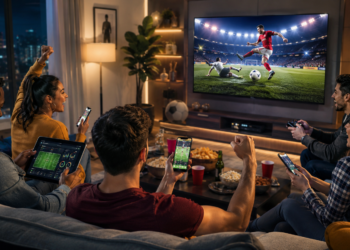
European sports fans increasingly move between television broadcasts, streaming services, social media, live statistics, messaging groups and mobile apps while the action is still taking place. For many supporters, watching the match itself has become only one part of a much larger digital routine.
Football remains at the centre of European sporting culture, but similar changes can be seen across Formula One, tennis, rugby, basketball and other sports.
Technology has not replaced traditional fandom. Instead, it has added new layers to it.
The rise of the second screen
One of the biggest changes is the emergence of what is often described as "second-screen" behaviour.
A supporter might watch a Champions League match on television while simultaneously checking player statistics on a phone, discussing a refereeing decision in a WhatsApp group and looking at reactions on social media.
The match is still the main event, but the conversation around it now happens instantly.
Twenty years ago, supporters might have waited until the next day to read newspaper analysis. Today, tactical diagrams, video clips, player ratings and opinions can appear online within minutes.
That has made sports coverage considerably more competitive.
Broadcasters are no longer competing only against other broadcasters. They are competing for attention against creators, podcasts, social platforms and thousands of fan communities.
Statistics have become part of everyday fandom
Sports data was once mainly the domain of coaches, scouts and serious analysts.
Now it is everywhere.
Football fans casually discuss expected goals, possession maps and pressing statistics. Basketball supporters follow shooting percentages and advanced player metrics. Formula One viewers can study tyre strategies, lap times and telemetry during a race.
Even fans who never consider themselves particularly interested in statistics are exposed to significantly more data than previous generations.
This has changed sports debates too.
The traditional argument about whether a player "had a good game" can now involve dozens of measurable statistics alongside the usual subjective opinions.
It does not mean the numbers always settle the argument. Quite often they simply create new ones.
Mobile phones have changed matchday behaviour
The smartphone is probably the single most important piece of technology behind this shift.
It allows supporters to carry almost the entire sports media ecosystem in their pocket.
A fan travelling home from work can receive team news, watch highlights, follow live commentary and discuss the match without ever opening a laptop.
This is particularly important for competitions with international audiences.
A Real Madrid supporter does not have to live in Madrid. A Manchester United fan does not have to live in Manchester. European clubs increasingly have supporters spread across Asia, Africa, North America and the Middle East.
Digital platforms give those distant supporters much more direct access to the club and its surrounding fan culture.
Sport and digital entertainment are increasingly overlapping
The expansion of sports technology has also blurred the boundaries between watching sport and interacting with it.
Fantasy football is perhaps the most obvious example.
Fans who once cared only about their own club may suddenly find themselves following a mid-table Premier League match because one of their fantasy players is involved.
Video games have created another connection. Titles based around football, basketball and Formula One introduce younger audiences to teams and athletes they may never have encountered through traditional broadcasting alone.
Sports-related prediction games and regulated wagering markets have also become part of the wider digital environment surrounding professional sport in a number of European countries.
This is one reason discussions about online betting trends in Europe increasingly sit alongside conversations about broadcasting, mobile technology and fan engagement. They are different activities, but they are developing within the same broader shift towards real-time digital interaction around sporting events.
At the same time, European countries take very different approaches to gambling regulation, advertising and consumer protection, meaning the experience can vary significantly from one market to another.
Social media has made athletes into media companies
Another major transformation is happening away from the field.
Athletes no longer need traditional newspapers or television networks to communicate with supporters.
Many can reach millions of people directly.
Instagram, TikTok, YouTube and other platforms allow players to show training sessions, travel, sponsorships and everyday life in ways that previous generations of athletes could not.
That has changed sports marketing.
A footballer is no longer valuable to a sponsor only because of what happens during 90 minutes on the pitch. Their digital audience can be equally important.
Some athletes now have social-media followings comparable with major clubs and broadcasters.
It also means sporting stories can develop incredibly quickly.
A single post from a player can become an international news story before a club has released an official statement.
Streaming is making sports audiences more fragmented
Television remains enormously important to European sport, particularly for major football competitions.
But the way fans access those broadcasts is changing.
Streaming has created more flexibility while also making sports rights increasingly complicated.
Different competitions may appear on different services, while highlights and short-form clips are distributed separately across social platforms.
As a result, supporters increasingly build their own combination of services rather than relying on a single television channel.
For sports organisations, the challenge is finding the right balance.
Traditional broadcasters can still deliver enormous audiences. Digital platforms, however, can reach younger viewers and international supporters in ways conventional television sometimes cannot.
The future is therefore unlikely to belong entirely to one format.
Most fans will probably continue moving between several.
The stadium still matters
With so much sport becoming digital, it might seem logical that physical attendance would become less important.
Yet the opposite can also happen.
The more sport becomes available online, the more valuable the unique atmosphere of actually attending an event can feel.
A packed football ground, a tennis crowd watching match point or thousands of Formula One supporters seeing cars arrive at the first corner cannot be fully reproduced through a screen.
That distinction helps explain why stadiums themselves are becoming more technologically sophisticated.
Mobile tickets, stadium Wi-Fi, digital payment systems and club apps are increasingly designed to connect the physical matchday with the digital services fans already use.
Technology is therefore not necessarily pushing supporters away from stadiums.
In many cases, it is following them inside.
The fan of the future will probably do even more
The next stage of sports fandom is unlikely to involve one revolutionary invention.
Instead, the technologies already surrounding sport will become more connected.
Live statistics could become more personalised. Broadcasts could offer viewers greater control over camera angles and commentary. Artificial intelligence may make it easier to find highlights involving particular players or teams.
What will probably remain unchanged is the basic reason people watch.
Sports work because nobody knows exactly what will happen.
Technology can provide more statistics, more opinions and more ways to follow the action, but it cannot remove that uncertainty without removing the thing that makes sport interesting in the first place.
European fans may now watch with a television in front of them and a smartphone in their hand, but when the decisive goal arrives in the final minute, the reaction is remarkably traditional.
Everything else can wait.