

MT (Title): Second Screen Culture: How Tech Changed How We Watch Sports
MD (Description): Explore how the second screen transformed sports viewing. From real-time analytics to social media, fantasy leagues, and interactive entertainment platforms.
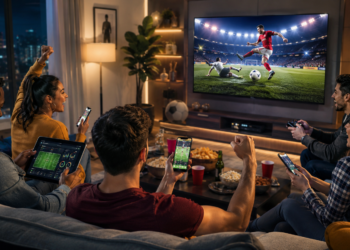
Picture a typical weekend in the modern living room. The television is illuminated, broadcasting a high-stakes football match, a tense tennis final, or a crucial basketball playoff game. However, if you look closely at the viewers, their eyes are not glued exclusively to the main screen. In their hands, illuminating their faces with a softer, secondary glow, are smartphones, tablets, or laptops. This is the era of the "second screen," a cultural and technological phenomenon that has fundamentally permanently altered the way we consume live sports.


Gone are the days when watching a game was a passive, one-way experience, where the viewer was completely at the mercy of the broadcaster’s chosen camera angles, selected replays, and designated commentators. Today, the modern sports fan is an active participant, a real-time data analyst, and a global communicator. The second screen has transformed sports consumption from a solitary or localized living room activity into a dynamic, interactive, and multi-dimensional ecosystem. By examining how this culture emerged and how it currently operates, we can understand not just the future of sports broadcasting, but the evolving nature of human attention and digital interaction.
The Evolution from Passive Consumption to Active Participation
For decades, the television set was an authoritarian device. It dictated what you watched, when you watched it, and how you watched it. If you missed a spectacular goal while fetching a drink, you had to wait and hope the network decided to show a replay. If you disagreed with the referee’s decision, your only outlet for frustration was shouting at the screen or complaining to whoever happened to be sitting next to you. The introduction of the smartphone shattered this paradigm, empowering the viewer to take control of their own viewing experience.
The shift toward active participation via the second screen is driven by several critical consumer demands:
This newfound autonomy has created a highly demanding audience. Because fans have the power to curate their own supplementary content, traditional broadcasters are no longer the sole gatekeepers of the sports narrative. The first screen provides the raw visual feed, but the second screen provides the context, the depth, and the control. This dynamic forces media companies to innovate, knowing that if the primary broadcast becomes stagnant or uninformative, the viewer’s attention will seamlessly, entirely shift to the device in their hands.
The Virtual Stadium: Social Media and Global Communities
Historically, the communal experience of watching sports was confined to the physical stadium or the local pub. You celebrated with the people in your immediate vicinity. Today, social media has constructed a massive, borderless "virtual stadium." Through the second screen, a fan sitting alone in their apartment in London can simultaneously celebrate a last-minute game-winner with a stranger in Tokyo, a friend in New York, and thousands of other passionate supporters worldwide.
The social media architecture of the second screen facilitates several unique modes of interaction:
This virtual stadium is often just as entertaining as the game itself. In fact, for many younger viewers, the social media discourse surrounding a sporting event is the primary draw. The collective groan that echoes across the internet when a star player misses a crucial penalty provides a profound sense of digital camaraderie. The second screen ensures that no matter where you are physically located, you never have to watch a game alone. It transforms a localized event into a synchronized global cultural moment, proving that the human desire for shared emotional experiences remains paramount, even in a highly digitized world.
Gamification and the Thrill of Real-Time Interaction
Human attention spans are evolving, and the modern viewer often requires continuous stimulation. Traditional sports broadcasts are filled with inherent downtime—commercial breaks, halftime intermissions, VAR (Video Assistant Referee) checks, and tactical pauses. Instead of enduring this downtime passively, fans turn to their second screens to maintain their adrenaline levels through gamification and interactive entertainment.
This craving for continuous engagement manifests in various interactive formats:
The gamification of the sports viewing experience proves that modern audiences do not just want to watch the action; they want to feel invested in it. Whether they are managing a virtual roster of players, voting on the game’s MVP, or engaging in fast-paced digital games during halftime, the second screen turns observation into participation. This intersection of live sports and interactive gaming creates a continuous loop of dopamine and excitement. It ensures that the viewer’s psychological engagement never drops, even when the referee blows the whistle for a fifteen-minute break.
The Data-Driven Fan: Analytics at Our Fingertips
The second screen has fundamentally elevated the sports IQ of the average viewer. We have transitioned from an era of "eye-test" analysis to an era of hyper-specific data. Fans no longer just debate whether a player is performing well; they use their smartphones to pull up advanced metrics to prove it. The democratization of sports data means that anyone with a secondary device can act as an amateur tactician or a shadow manager.
The data available on the second screen empowers fans to analyze the game through several advanced lenses:
This influx of data fundamentally changes the discourse surrounding sports. It elevates barroom debates into analytical discussions backed by hard numbers. Furthermore, it allows fans to appreciate the game on a much deeper, more intellectual level. When a viewer can look at their smartphone and see that a striker has made twenty high-intensity sprints in the last ten minutes, they gain a profound appreciation for the athletic endurance required at the professional level. The second screen does not distract from the sport; it magnifies its intricacies, allowing fans to see the hidden mathematics and strategies operating beneath the surface of the game.
The Broadcaster's Dilemma and Adaptation
The rise of the second screen initially presented a massive threat to traditional television networks. Broadcasters realized that if viewers were looking down at their phones, they were not looking at the television commercials, which threatened the core revenue model of sports media. However, rather than fighting a losing battle against the smartphone, intelligent broadcasters decided to co-opt it. They realized that the key to survival was to integrate the second screen into the primary broadcast ecosystem.
Broadcasters and sports leagues have adapted to this culture through several innovative strategies:
By embracing the second screen, broadcasters have transformed a potential distraction into a powerful tool for user retention. They understand that a viewer who is simultaneously watching the game on TV and interacting with the official league app on their tablet is a deeply engaged consumer. This synergy between the first and second screens represents the future of media consumption: a holistic, interconnected web of content where the television provides the spectacle, and the mobile device provides the personalized engagement.
Conclusion: A Deeper Connection to the Game
It is easy for traditionalists to lament the rise of the second screen, viewing it as a symptom of a distracted, attention-deficit society. However, a deeper analysis reveals the exact opposite. The second screen has not pulled fans away from the sport; it has pulled them closer to it. It has provided the tools to understand the game better, the platforms to share the emotional highs and lows with a global community, and the interactive outlets to stay engaged during the inevitable lulls in action.
As we look toward the future—where Augmented Reality glasses may merge the first and second screens into a single spatial computing experience—the core philosophy remains the same. Technology serves to enrich our passions. The second screen culture proves that sports are no longer just an event we watch; they are a multi-dimensional experience we inhabit, analyze, and share. As long as the games continue to thrill us, our devices will remain in our hands, acting as the perfect digital companions to the unpredictable drama of live sports.